
The Gut-Brain Axis Diet: What to Eat for Gut and Mental Health
Part three of a three-part series – the practical piece.
This is the last newsletter turned blog post in the series, and it’s the question people usually ask first: what should I actually eat? Part one mapped the wiring – the vagus nerve, the immune system, short-chain fatty acids. Part two covered the chemistry – serotonin, GABA, cortisol, and the bacterial signatures in depression, anxiety, bipolar disorder, and schizophrenia. This piece turns all of that into a gut-brain axis diet you can actually put on a plate.
The evidence here comes from real dietary intervention trials – the SMILES trial, which tested a Mediterranean-style diet against a supportive-therapy control in adults with major depression, and a 17-week study that compared a high-fibre diet against a high-fermented-food diet head to head. There’s also a section on gut permeability and where testing – a stool analysis, or a marker like zonulin – fits in.
What shapes the gut microbiota through diet
A 2021 review in Advances in Nutrition pulled together the human and animal evidence on which dietary factors shift the microbiota toward, or away from, a mental-health-supportive profile. The broad pattern:
| Supports the axis | Works against it |
|---|---|
| Mediterranean-pattern eating – vegetables, fruit, legumes, olive oil, fish | Refined carbohydrates and added sugar |
| Fibre & prebiotics – oats, legumes, inulin-rich vegetables | Saturated fat, particularly alongside refined carbs (the “Western diet” combination) |
| Fermented foods – kefir, yoghurt, sauerkraut, kimchi | Ultra-processed foods generally |
| Polyphenols – berries, dark chocolate, olive oil, pomegranate | Emulsifiers (common in processed foods) |
| MUFAs & PUFAs – olive oil, oily fish, nuts, seeds | High intake of processed meat |
| Plant-based protein – legumes, nuts | Certain sweeteners (sucralose shows the clearest signal) |
What ties almost all of these categories together is diversity and quality. Bacteria in the colon are eating what you eat, and species diversity tracks with the number of different plant foods in a diet, not just the total amount of fibre. I’ve written more broadly on supporting gut health day to day here: Nurturing Your Gut: The Key to a Healthier You.
The Mediterranean diet and gut-brain health, tested directly
The clearest clinical evidence for a dietary pattern, rather than a single food or supplement, improving mood comes from the SMILES trial: a 12-week Mediterranean-style dietary intervention, delivered through one-on-one sessions with a dietitian, produced significantly greater improvement in depression symptoms than a social-support control in adults with major depressive disorder. It’s since been corroborated twice more – once in young men with clinical depression (the AMMEND trial), and once in a Mediterranean diet combined with fish oil (HELFIMED), which also improved mental health outcomes relative to a social-support control.
Fermented foods, tested head to head against fibre
The most direct comparison of two whole-dietary approaches came from a 17-week randomised trial in Cell that put a high-fibre diet up against a high-fermented-food diet in healthy adults. Both diets changed the microbiome, but only the fermented-food diet reduced inflammatory markers such as IL-6 and modulated immune responses, a striking finding given how much attention fibre alone tends to get.
Diversity – of plants, of fermented foods, of fibre types – shows up again and again as the thing that matters more than any single “superfood.”
A word on fat, because context matters
The dietary factors linked to a damaged gut lining in the research are worth being precise about, because “high-fat diet” gets used loosely. The leaky-gut literature specifically implicates the Western dietary pattern, high in saturated fat and refined carbohydrate together, the standard combination used to induce obesity in rodent studies, not fat as a category. The same 2021 Advances in Nutrition review that built the table above lists saturated fat under the factors that reduce microbial diversity, and MUFAs and PUFAs (olive oil, oily fish, nuts) under the factors that support it.
This matters for anyone following a well-formulated ketogenic or low-carbohydrate protocol, which looks nothing like the rodent “high-fat diet” models in this research. In one trial, a modified Mediterranean ketogenic diet – under 20g of carbohydrate a day, with the fat coming from extra virgin olive oil, fish, and lean meats rather than saturated fat – produced favourable shifts in the microbiota that correlated with improved Alzheimer’s biomarkers in adults with mild cognitive impairment. Fat quality, not fat quantity, is what the evidence tracks. I’ve written more on how a ketogenic approach interacts with the gut microbiome here: The Ketogenic Diet and the Microbiome: Busting Myths and Unveiling Benefits.
What a gut-brain axis diet looks like in practice
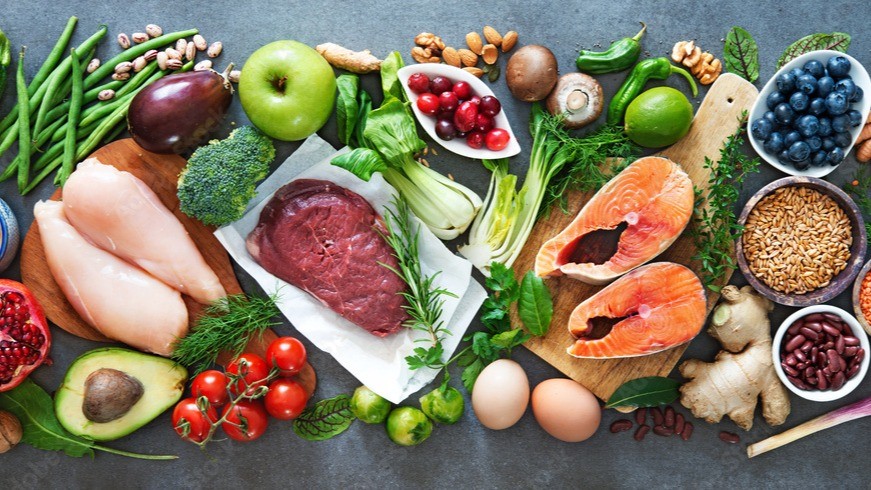
This is illustrative, not a prescription – the point is to show what a microbiota-supporting day looks like on a plate, built from everything above: Mediterranean-pattern, high in plant diversity and fibre, with fermented foods and quality fats worked in.
- On waking: Warm water with lemon, or a turmeric latte with coconut milk if you’re up for the extra admin.
- Breakfast: Plain full-cream yoghurt or kefir with mixed berries, walnuts, and a spoon of ground flaxseed.
- Mid-morning: A piece of fruit with a small handful of almonds, plus half a cup of bone broth (for GI support).
- Lunch: A big mixed salad, as many colours and plants as you can fit in, with lentils or chickpeas, tinned sardines or chicken breast, an olive oil and lemon dressing, and a spoonful of sauerkraut or kimchi on the side.
- Afternoon: A square or two of dark chocolate (80%+) with a small handful of pumpkin seeds.
- Dinner: Grilled chicken breast or sirloin steak, roasted vegetables, a small serving of quinoa, and, if you enjoy it, a side of fermented vegetables again.
A note before you try this: if you have a diagnosed inflammatory bowel condition – IBD, coeliac disease, IBS, or similar – please don’t treat this as a template to follow unsupervised. High-fibre, high-fermented-food eating can worsen symptoms during a flare, and what’s protective for one gut can be provocative for another.
Gut permeability and where testing fits in
The mechanism connecting diet to gut permeability is well mapped. According to a 2024 review in the Journal of Microbiology and Biotechnology, diets high in refined carbohydrate and saturated fat weaken the proteins holding the gut’s tight junctions together, including zonulin, allowing bacterial endotoxins (lipopolysaccharides) to leak into the bloodstream. This state, called metabolic endotoxemia, is linked to the low-grade inflammation seen in depression and anxiety.
This is where testing has a practical use: a zonulin marker (stool) gives an objective read on gut permeability, and a stool analysis can show whether the butyrate-producing, anti-inflammatory bacteria discussed across this series are actually present in adequate numbers. If you’ve made dietary changes and want to know whether they’re landing, or if gut and mood symptoms persist despite eating well, testing turns a guess into a data point.
Frequently asked questions
What is a gut-brain axis diet?
A gut-brain axis diet is a Mediterranean-pattern way of eating — rich in plant diversity, fibre, fermented foods, and quality fats such as olive oil and oily fish — shown in clinical trials to support both the gut microbiome and mood.
What foods are best for gut health and mental health?
Fermented foods (kefir, yoghurt, sauerkraut, kimchi), fibre-rich plants, polyphenol-rich foods (berries, dark chocolate, olive oil), and omega-3-rich fish are the categories most consistently linked to a mental-health-supportive gut microbiome.
Can diet really help with depression?
Yes. Randomised controlled trials, including the SMILES, AMMEND, and HELFIMED trials, have found that a Mediterranean-style dietary intervention produces significantly greater improvement in depression symptoms than a social-support control.
Is a ketogenic diet bad for gut health?
Not when it’s done properly. The leaky-gut research implicates the Western dietary pattern – high saturated fat combined with refined carbohydrate – not fat as a category. A ketogenic diet built around olive oil, fish, and lean meats has been shown to produce favourable shifts in the gut microbiome.
What is a zonulin test, and do I need one?
Zonulin is a protein marker that can be measured in stool to give an objective read on gut permeability. It’s most useful if you’ve made dietary changes and want to know whether they’re working, or if gut and mood symptoms persist despite eating well.
That closes out this series. If you want to talk through where you fit into any of this, I’d be glad to help.
Hannah Kaye — Nutritional Therapist · Functional Nutrition · Nutritional Psychiatry
References
- Berding, K., et al. Diet and the Microbiota-Gut-Brain Axis: Sowing the Seeds of Good Mental Health. Advances in Nutrition, 12(4), 1239–1285 (2021).
- Jacka, F.N., O’Neil, A., Opie, R., et al. A randomised controlled trial of dietary improvement for adults with major depression (the ‘SMILES’ trial). BMC Medicine, 15, 23 (2017).
- Bayes, J., et al. The effect of a Mediterranean diet on the symptoms of depression in young males (the “AMMEND” study): a randomized controlled trial. American Journal of Clinical Nutrition (2022).
- Parletta, N., et al. A Mediterranean-style dietary intervention supplemented with fish oil improves diet quality and mental health in people with depression: A randomized controlled trial (HELFIMED). Nutritional Neuroscience, 22(7), 474–487 (2019).
- Wastyk, H.C., et al. Gut-microbiota-targeted diets modulate human immune status. Cell, 184(16) (2021).
- Nagpal, R., Neth, B.J., Wang, S., Craft, S., Yadav, H. Modified Mediterranean-ketogenic diet modulates gut microbiome and short-chain fatty acids in association with Alzheimer’s disease markers in subjects with mild cognitive impairment. EBioMedicine, 47, 529–542 (2019).
- Chae, Y.R., Lee, Y.R., Kim, Y.S., Park, H.Y. Diet-Induced Gut Dysbiosis and Leaky Gut Syndrome. Journal of Microbiology and Biotechnology (2024).