
Gut Bacteria and Mental Health: What the Research Shows
Part two of a three-part series – the mechanisms connecting gut bacteria and mental health.
In part one of this series, I mapped out how the gut and brain are wired together: the vagus nerve, the immune system, and short-chain fatty acids that cross the blood-brain barrier. This week is about the gut bacteria and mental health connection specifically – the chemistry of serotonin, GABA, and cortisol, and what changes when gut bacteria shift out of balance. This is a lot of the mechanism behind why mood and gut symptoms so often move together.
The research this week includes real human data alongside the animal work: a metagenomics study of more than a thousand people, randomised trials testing probiotics both alongside antidepressants and entirely on their own, and microbiome comparisons in people with diagnosed anxiety disorders, bipolar disorder, and schizophrenia. Part three turns all of this into something practical: what to actually eat, and where testing fits in.
Serotonin, GABA, and the tryptophan fork in the road
Serotonin is the neurotransmitter most associated with mood, and the detail that surprises people is where it’s made. Only around 5% of the body’s serotonin is produced in the brain; roughly 95% is made in the gut, released by cells lining the intestinal wall called enterochromaffin cells. A 2024 review in Microbiological Research sets out how gut bacteria influence this directly, by producing short-chain fatty acids that switch on the enzyme responsible for gut serotonin production.
Serotonin is built from the amino acid tryptophan, and tryptophan has two possible routes once absorbed. Only around 1% goes toward serotonin; the rest is normally shunted down the kynurenine pathway. Gut bacteria can push this balance in either direction: certain species suppress the kynurenine route and free up more tryptophan for serotonin, while chronic stress does the opposite.
This pathway has already been targeted directly in human trials. In one, adding the probiotic Lactobacillus plantarum 299v to a standard antidepressant improved cognitive performance in people with depression compared with the antidepressant alone. In another, a probiotic taken on its own, with no antidepressant involved, significantly reduced depression scores in 110 people with major depressive disorder over 8 weeks, outperforming both a prebiotic and a placebo. A third trial testing Bifidobacterium breve CCFM1025 against placebo found it outperformed placebo on two standard depression rating scales, linked to measurable shifts in tryptophan metabolism.
The same body of research covers GABA, the brain’s principal calming neurotransmitter. Several gut bacteria, including strains of Lactobacillus and Bifidobacterium, produce GABA directly, using an enzyme called glutamate decarboxylase to convert glutamate into GABA. Glutamate is an excitatory signal and GABA an inhibitory one, so this conversion amounts to gut bacteria adjusting the ratio between the brain’s accelerator and its brakes.
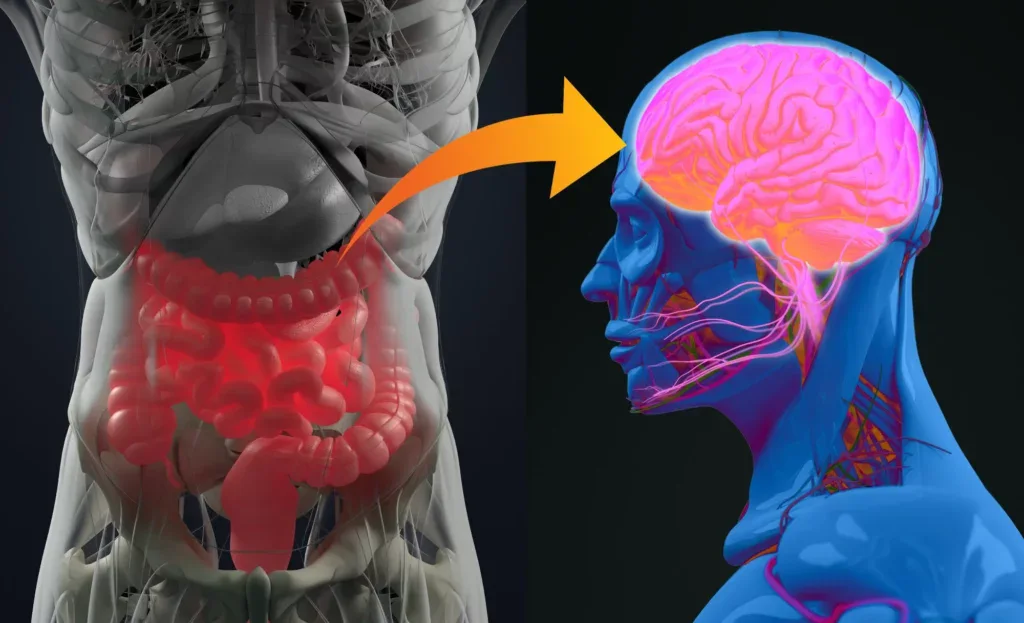
Most of the serotonin behind your mood isn’t made in your brain. It starts in your gut, and gut bacteria have a direct hand in how much gets made.
The stress hormone loop: HPA axis and cortisol
Stress reaches the gut through a defined hormonal chain, laid out in a 2024 review in Cells: the brain releases a hormone called CRF, which travels to the pituitary gland and triggers ACTH, which in turn signals the adrenal glands to release cortisol. This is the hypothalamic-pituitary-adrenal, or HPA, axis, and it runs in both directions with the gut.
Animals raised with no gut bacteria show an exaggerated version of this response: their HPA axis overreacts to stress, and they display more anxiety- and depression-like behaviour than animals with a normal microbiome. The loop runs the other way too. The same stress response that triggers cortisol release also changes the proteins holding the gut lining’s tight junctions together, making the gut more permeable, which is itself linked to the low-grade inflammation seen in some cases of depression and anxiety.
This same stress hormone loop reaches further than mood. It’s also implicated in how fast the body ages at a cellular level, which I’ve written about separately: The Impact of Stress on Biological Aging.
Psychobiotics: when gut bacteria change behaviour directly
Those trials sit inside a wider concept. The term psychobiotics was coined in 2013 to describe probiotics with a measurable effect on mental health, and some of the supporting evidence is unusually direct. A 2022 review in Brain Research Bulletin describes an experiment in which researchers swapped the gut bacteria between two mouse strains with different natural behavioural profiles. Each animal shifted toward the other strain’s typical behaviour and brain chemistry, the effect travelled with the bacteria, not the animal.
The clearest human evidence comes from a metagenomics study of more than a thousand people, which found that certain butyrate-producing bacteria – Faecalibacterium and Coprococcus – were consistently linked to a higher-quality diet and better outcomes in depression, even in people already being treated with antidepressants.
What this looks like in anxiety specifically
Anxiety disorders have their own microbial signature, distinct from depression. A 2024 review in the International Journal of Molecular Sciences describes gene-sequencing studies comparing people with generalised anxiety disorder to healthy controls: two bacterial groups (Fusicatenibacter and Christensenellaceae) ran consistently lower, while compared to people with major depressive disorder, generalised anxiety showed more Sutterella and less Faecalibacterium. A separate study of social anxiety disorder found a different microbial signature again. Specific probiotic strains, including Lactobacillus plantarum P-8 and JYLP-326, are now being trialled directly for anxiety symptoms, with early results showing improvement.
Bipolar disorder: a related but distinct signature
Bipolar disorder shares some of the same gut signatures as depression, but a 2024 review in Frontiers in Psychiatry draws out where it diverges. People with untreated bipolar disorder tend to have lower levels of several butyrate-producing bacteria – Roseburia, Faecalibacterium, and Coprococcus – the same broad group implicated in depression. Butyrate influences hippocampal function and the expression of BDNF, a protein linked to antidepressant-like effects, so a shortage of the bacteria that make it is a plausible contributor to symptoms.
Faecalibacterium specifically stands out: lower levels track with greater disease severity, more psychotic symptoms, and disrupted sleep in people with bipolar disorder. The two mood disorders are distinguishable at the bacterial level too. Depression is typically marked by higher Alistipes and Parabacteroides with lower Prevotella, while bipolar disorder tends to show higher Bifidobacterium and Oscillibacter instead.
Schizophrenia: bacteria showing up in the wrong place
The gut-brain axis extends to schizophrenia too, and one finding stands out. A 2023 review in Nutrients describes an experiment in which researchers transplanted Streptococcus vestibularis, normally an oral bacterium, into mice, and the mice went on to develop schizophrenia-like behaviour. People with schizophrenia have measurably higher levels of oral bacteria living in the gut than healthy controls do.
As with depression and bipolar disorder, people with schizophrenia show reduced levels of butyrate-producing bacteria – Faecalibacterium, Roseburia, and Butyricicoccus – and this reduction tracks inversely with a cluster of inflammatory markers that run high in the condition. Specific short-chain fatty acids correlate with cognitive symptoms directly: lower caproic acid and higher isovaleric acid are both associated with worse memory scores in people with schizophrenia. Diet is one of the more direct ways to shift this bacterial balance, and I’ve covered how a ketogenic approach reshapes the gut microbiome, including in psychiatric conditions, here: The Ketogenic Diet and the Microbiome: Busting Myths and Unveiling Benefits.
A note on the evidence: this isn’t only correlational. The microbiome comparisons – gut bacteria differing between people with depression, anxiety, bipolar disorder, or schizophrenia and those without – are correlational on their own. But this piece also includes real intervention evidence: bacteria transplants that carry behavioural traits between animals, and randomised, placebo-controlled human trials, including one where a probiotic taken on its own, with no antidepressant involved, outperformed both a placebo and a prebiotic for depression symptoms. That’s a directly tested cause-and-effect claim, not an observed association, and it’s the kind of evidence the field is increasingly built on.
Gut Bacteria and Mental Health: Why This Matters
This piece is most relevant if you recognise yourself in any of these:
- Managing anxiety or depression alongside gut symptoms – bloating, irregular bowels, reflux – that seem to flare together (if SIBO is part of what’s going on for you, I’ve written more on that specific connection here: SIBO, Mental Health, and the Gut-Brain Axis)
- Currently on an antidepressant and curious about the evidence for probiotics or dietary strategies as an addition, not a replacement
- A family history of mood disorders alongside digestive issues
- Wanting to understand the mechanism behind why stress so reliably affects your gut, and your gut affects your stress
- A personal or family history of bipolar disorder or schizophrenia – this research is newer, but the same underlying biology applies
Frequently asked questions
How do gut bacteria affect serotonin?
Around 95% of the body’s serotonin is produced in the gut, not the brain. Gut bacteria influence this directly by producing short-chain fatty acids that activate the enzyme responsible for gut serotonin production, and by shifting how much dietary tryptophan is diverted toward serotonin versus the competing kynurenine pathway.
Can probiotics help with depression or anxiety?
Randomised, placebo-controlled human trials have found that certain probiotic strains – including Lactobacillus plantarum 299v and Bifidobacterium breve CCFM1025 – reduce depression scores, both as an add-on to antidepressants and on their own. Evidence for anxiety-specific strains is newer but growing.
Do gut bacteria affect the stress response?
Yes. Gut bacteria interact with the HPA axis, the hormonal chain running from brain to adrenal glands that produces cortisol. Animals with no gut bacteria show an exaggerated stress response, and chronic stress itself changes the gut lining in ways linked to inflammation.
Is there a gut bacteria signature for bipolar disorder or schizophrenia?
Yes. Both conditions show reduced levels of butyrate-producing bacteria such as Faecalibacterium and Roseburia, similar to what’s seen in depression, but with distinguishing features specific to each condition.
Part three is the practical piece: what to actually eat to support this system, and where testing – a stool analysis, or a marker like zonulin for gut permeability – might fit in, if any of this feels relevant to you.
If anything here raises a question about your own gut or mood, I’d be glad to talk it through.
Hannah Kaye – Nutritional Therapist · Functional Nutrition · Nutritional Psychiatry
References
- Gut microbiota modulates neurotransmitter and gut-brain signaling. Microbiological Research (2024).
- Verma, A., Inslicht, S.S., Bhargava, A. Gut-Brain Axis: Role of Microbiome, Metabolomics, Hormones, and Stress in Mental Health Disorders. Cells, 13(17), 1436 (2024).
- The gut microbiota-brain axis, psychobiotics and its influence on brain and behaviour: A systematic review. Brain Research Bulletin (2022).
- Mind, Mood and Microbiota — Gut–Brain Axis in Psychiatric Disorders. International Journal of Molecular Sciences, 25(6), 3340 (2024).
- Zhao, J., Liu, J., Feng, J., Liu, X., Hu, Q. The gut microbiota-brain connection: insights into major depressive disorder and bipolar disorder. Frontiers in Psychiatry, 15 (2024).
- Identification of gut microbiome markers for schizophrenia delineates a potential role of Streptococcus. Nutrients, 15(20), 4391 (2023).
- Rudzki, L., et al. Probiotic Lactobacillus plantarum 299v decreases kynurenine concentration and improves cognitive functions in patients with major depression. Psychoneuroendocrinology, 100, 213–222 (2019).
- Kazemi, A., et al. Effect of probiotic and prebiotic vs placebo on psychological outcomes in patients with major depressive disorder: A randomized clinical trial. Clinical Nutrition, 38(2) (2019).
- Bifidobacterium breve CCFM1025 attenuates major depression disorder via regulating gut microbiome and tryptophan metabolism: A randomized clinical trial. Brain, Behavior, and Immunity (2022).
- Valles-Colomer, M., et al. The neuroactive potential of the human gut microbiota in quality of life and depression. Nature Microbiology, 4, 623–632 (2019).